Introduction Video
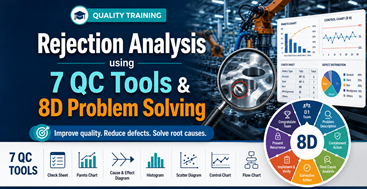
Rejection Analysis Using 7 QC Tools And 8D Problem Solving
Learn rejection analysis, 7 QC tools, and 8D problem solving to improve quality and reduce defects.
Rejection Analysis Using 7 QC Tools And 8D Problem Solving
Learn rejection analysis, 7 QC tools, and 8D problem solving to improve quality and reduce defects.
- 251 Enrolled
-
Description
Learn how to identify, analyze, and reduce rejection in manufacturing and quality processes using the 7 Quality Control Tools and the 8D Problem-Solving methodology. This course helps participants understand root cause analysis, corrective actions, defect prevention, and continuous improvement techniques to achieve better quality performance.
Course Details
Course Overview
In today’s competitive manufacturing environment, even a small rejection can lead to production loss, customer dissatisfaction, increased cost, and repeated quality issues. To achieve consistent quality, professionals must know how to identify the real cause of defects and take effective corrective and preventive actions.
This course is designed to help participants master Rejection Analysis using the 7 Quality Control Tools and 8D Problem-Solving Methodology. Through structured learning, practical examples, and real-world case studies, participants will learn how to analyze defects, find root causes, reduce rejections, and prevent recurrence.
The course is highly useful for professionals working in quality, production, manufacturing, maintenance, engineering, process improvement, and supplier quality functions.
Why This Course Is Important
Rejections, rework, and repeated defects are common challenges in every industry. Many times, problems are solved temporarily without identifying the actual root cause. This leads to recurrence, customer complaints, increased cost, and poor productivity.
This course helps participants move from temporary correction to permanent problem solving.
Participants will learn how to use simple but powerful tools to:
- Analyze defects and rejection trends.
- Identify the root cause of quality problems.
- Reduce rework, scrap, and customer complaints.
- Improve process stability and product quality.
- Prepare effective 8D reports.
- Implement corrective and preventive actions.
- Build a disciplined problem-solving culture at the workplace.
What You Will Learn
By joining this course, participants will gain practical knowledge of how to apply the 7 QC Tools and 8D methodology in day-to-day industrial problems.
The course covers:
- Fundamentals of quality systems and defect management.
- Understanding rejection, rework, scrap, and their impact on business.
- Application of the 7 Quality Control Tools for problem analysis.
- Step-by-step rejection analysis methods.
- Root cause identification and validation.
- Corrective and preventive action planning.
- 8D problem-solving process and report preparation.
- Practical industrial examples and case studies.
The 7 Quality Control Tools Covered
Participants will learn the purpose, preparation method, and practical application of each QC tool:
- Cause-and-Effect Diagram
- Check Sheet
- Control Chart
- Histogram
- Pareto Chart
- Scatter Diagram
- Flow Chart
These tools help participants understand problems with data, identify patterns, prioritize major defects, and take the right actions based on facts.
8D Problem-Solving Methodology
The 8D methodology is one of the most effective structured problem-solving approaches used by industries worldwide. It helps teams solve problems in a disciplined and systematic way.
Participants will learn how to:
- Define the problem clearly.
- Form the right problem-solving team.
- Take containment actions.
- Identify and verify root causes.
- Select permanent corrective actions.
- Prevent recurrence.
- Recognize team efforts.
- Prepare professional 8D reports.
Course Objectives
After completing this course, participants will be able to:
- Understand the importance of rejection analysis in quality improvement.
- Apply the 7 QC Tools for defect and rejection analysis.
- Identify root causes using data-based problem-solving techniques.
- Reduce repeated defects, rework, scrap, and customer complaints.
- Prepare clear and effective 8D reports.
- Support continuous improvement activities in their organization.
- Improve problem-solving confidence in real workplace situations.
Who Should Attend?
This course is suitable for:
- Quality Engineers
- Production Engineers
- Manufacturing Engineers
- Process Engineers
- Maintenance Engineers
- Supervisors and Team Leaders
- Supplier Quality Professionals
- Continuous Improvement Professionals
- Students and freshers aspiring to work in manufacturing and quality roles
Course Duration and Format
Duration: 2 Weeks
Daily Commitment: Minimum 2 hours per day
Access Period: 6 Months from the date of enrollmentLearning Method
Participants will learn through recorded video lectures, practical examples, assignments, exercises, and discussions. Multiple language support will be provided wherever applicable.
The course is designed to make learning simple, practical, and industry-focused.
Certification
Participants will receive a certificate upon successful completion of the course, issued by Kriatec Services Pvt Ltd.
Why Enroll Now?
This course is not just about learning tools. It is about developing the ability to solve real quality problems confidently.
By mastering rejection analysis, 7 QC Tools, and 8D problem solving, participants can contribute directly to reducing defects, improving productivity, satisfying customers, and building a strong quality culture in their organization.
Enroll now and strengthen your practical problem-solving skills for industrial excellence.
-
-
Introduction And Objectives Of 7 QC Tools
- Introduction And Objectives Of 7 QC Tools
- Introduction And Objectives Of 7 QC Tools
-
Cause And Effect Diagram
- Cause And Effect Diagram
- Cause And Effect Diagram
- Case Study On Cause And Effect Diagram
-
Pareto Diagram
- Pareto Diagram
- Pareto Diagram
- Case Study On Pareto Diagram
-
Control Chart
- Control Chart
- Control Chart
- Case Study On Control Chart
-
Scatter Diagram And Histogram
- Scatter Diagram And Histogram
- Scatter Diagram And Histogram
-
Stratification And Check Sheet
- Stratification And Check Sheet
- Stratification And Check Sheet
-
Live Industrial Case Study
- Case Study 1 Session1
- Live Industry Case Study Session 2
-
Need And Usage Of 8D
- Need And Usage Of 8D
- Need And Usage Of 8D
-
Steps To Follow In 8D
- Steps To Follow In 8D
- Steps To Be Followed In 8D
-
8D Format
- 8D Format
- Format Of 8D Problem Solving
-
Example 1 Of 8D
- Example 1 Of 8D
- Live Examples In Action
-
Example 2 Of 8D
- Example 2 Of 8D
- Live Examples In Action
-
Example 3 Of 8D
- Example 3 Of 8D
- Live Examples In Action
-
Course Feedback
-
Introduction And Objectives Of 7 QC Tools
-
A Virtual tour about this course